Resources with keywords: PPE
Autochthonous clade Ib transmission confirmed in EU/EEA. Outside Africa, 97% of cases are male, 89% MSM — pattern relevant to clinical triage and ED screening protocols. Laboratory personnel should note that standard dermatopathology laboratory procedures (formalin fixation) adequately inactivate orthopoxviruses; however, unfixed specimens require BSL-2 handling. ECDC recommends JYNNEOS post-exposure prophylaxis for HCWs with unprotected exposure within 4 days.
HCWs caring for mpox patients without adequate PPE (gown, gloves, eye protection, N95 for aerosol-generating procedures) face direct contact transmission risk. All clades (Ia, Ib, IIb) circulating globally. Clade Ib recombinant with Ia/IIb genomic elements detected in February 2026; biological behavior not yet fully characterized. Diagnostic laboratory personnel handling skin lesion specimens must use BSL-2 enhanced precautions. JYNNEOS vaccine recommended for HCWs at occupational risk.
This guidance refers only to the following viral hemorrhagic fevers: Ebola, Marburg, Lassa, Crimean Congo Hemorrhagic Fever (CCHF), and the South American Hemorrhagic Fevers (i.e., those caused by Junin, Machupo, Chapare, Guanarito and Sabia viruses).
Covers the use of personal protective equipment, testing, antiviral treatment, patient investigations, monitoring of exposed persons, and antiviral chemoprophylaxis of exposed persons
Summary of changes
This updated guidance identifies select occupational groups that may be at increased risk of exposure to novel influenza A viruses. Specific recommendations for these groups may be updated as CDC learns more during this evolving situation. Persons in these occupational groups should consult with their supervisor or their employer’s worker safety team to determine how best to apply these recommendations.
WHO Laboratory Biosafety Manual 4th edition (LBM4) are available in all UN official languages and Vietnamese:
LBM4 core doc https://iris.who.int/handle/10665/337956
Risk assessment monograph https://iris.who.int/handle/10665/337966
Lab design monograph https://iris.who.int/handle/10665/337960
Outbreak monograph https://iris.who.int/handle/10665/337959
Biosafety programme management monograph https://iris.who.int/handle/10665/337963
Biosafety cabinets monograph https://iris.who.int/handle/10665/337957
Decontamination monograph https://iris.who.int/handle/10665/374887
PPE monograph https://iris.who.int/handle/10665/337961
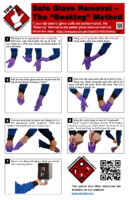 PPE/Safe Glove Removal –The “Beaking” Method (PDF, Video, Poster/Handouts/Factsheets/Guide)
If your lab coat or glove cuffs are contaminated, the “Beaking” Method is the safest glove removal method.
Targeted audience:
Biosafety Professionals
Researchers Laboratorians
Clinical / Diagnostic Laboratorians
Shipping / Receiving Staff
Students
Trainers / Educators
Part 2 outlines what makes a good mask study and why so many fail.