
Fungus/Fungi Toolbox for biosafety/biosecurity professionals: current and relevant resources compiled from organizations, government agencies, and news outlets.

6/1/2026
Share/Suggest a ResourceQuestions, Comments, Suggestions? Leave Feedback.
Fungus/Fungi Toolbox for biosafety/biosecurity professionals: current and relevant resources compiled from organizations, government agencies, and news outlets.
Share/Suggest a ResourceQuestions, Comments, Suggestions? Leave Feedback.
International experts reach consensus on a set of descriptors to describe how pathogens are transmitted through the air and the related modes of transmission.
Cristina ML, Spagnolo AM, Sartini M, Carbone A, Oliva M, Schinca E, Boni S, Pontali E
This pathogenic fungus shows an innate resilience, enabling survival and persistence in healthcare environment and the ability to rapidly colonize the patient’s skin and be easily transmitted within the healthcare setting, thus leading to a serious and prolonged outbreak.
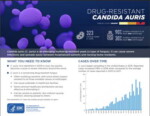
C. auris is the first fungal pathogen designated an urgent antimicrobial resistance threat. 6,304 U.S. clinical cases in 2024; estimated ~7,000 in 2025. C. auris persists on surfaces and medical equipment for weeks; HCWs involved in wound care, catheter insertion, and line management are at highest risk of pathogen carriage and inadvertent transmission. Clinical mycology laboratory personnel should use BSL-2 precautions. Environmental sampling of patient rooms is recommended. Echinocandin-resistant strains increasing; consult infectious disease specialist for treatment.
Kurutz A, Innes GK, Sherman A, et al.
Candida auris, a frequently multidrug-resistant fungal pathogen, can spread within health care facilities. Dialysis facilities face particular infection prevention and control (IPC) challenges because their patients require complex medical care and frequent invasive procedures.
Ghai RR, Sajewski ET, Blass M, et al.
Twelve members of an extended family developed mild-to-moderate histoplasmosis infections after touring the Venado Caves in Costa Rica.
Zucker J, Caplan AS, Gunaratne SH, et al.
5 cases diagnosed in NYC in summer 2024, previously not seen in the US.
Denning D
The annual total of deaths from fungal disease worldwide has risen to 3.75 million, double the previous estimate, according to this preprint paper.
Gold J, Adjei S, Gundlapalli AV, Huang YA, Chiller T, Benedict K, et al.
COVID-19 infection is a substantial risk factor for certain fungal infections, particularly those caused by invasive molds.
Yadav A, Wang Y, Jain K, Panwar VAR, Kaur H, Kasana V, Xu J, Chowdhary A
The authors analysed the microbial cultures of skin and ear swabs of 87 dogs in Delhi and performed fungal meta-barcode sequencing of ear and skin samples of 7 dogs with confirmed otitis externa (OE).
Smith RM, Schaefer MK, Kainer MA, et al.
The authors concluded: Analysis of data from a large, multistate outbreak of fungal infections showed substantial morbidity and mortality.
Cavallone IN, et al.
Chromoblastomycosis (CBM) is a neglected, chronic subcutaneous disease with progressive development, caused by a variety of melanized fungal species, mainly Fonsecaea pedrosoi. We report a case of CBM in which Alternaria alternata was identified as the etiological agent in a patient with no history of immunodeficiency or other medical conditions that impair the immune response.
Santana DJ, et al.
C. auris has a specific and dominant adhesin called Surface Colonization Factor (SCF1), which adheres by cation-dependent interactions to a wide range of biotic and abiotic surfaces.
Discusses the spread of Valley fever, under-reporting, diagnostic failures, effects of climate change, etc.
This is a disease-specific page form the CDC
This report includes specific Recommendations for Clinical Laboratories
Cat-transmitted sporotrichosis has emerged as a zoonotic epidemic and major public health threat in Brazil with the potential of spreading to the United States
This document is the first global effort to systematically prioritize fungal pathogens, considering their unmet research and development (R&D) needs and perceived public health importance.
Caplan AS, Chaturvedi S, Zhu Y, et al.
Approximately 95% of U.S. coccidioidomycosis (Valley fever) cases are reported from Arizona and California. Incidence of coccidioidomycosis in Arizona approximately doubled during 2005–2022.
Dalla Lana DF, Falci DR, Sanha V, Jaskulski Filho SD, Schuch F, Pasqualotto AC
Full article available for a cost; summary: https://agencia.fapesp.br/mortality-rate-from-icandida-i-infections-remains-high-in-brazil-despite-therapeutic-advances/41849/