
Events posted are for the biosafety community and are not automatically approved for CM Points.
Approved trainings can be found here.

Have an event? List it in the Biosafety Calendar.
Events submitted must be approved and may take up to 3 business days to appear on the website.
If you login first you will be able to modify your calendar events if you need to.

Events

Views Navigation

Event Views Navigation

Today
  • Large-scale Biosafety

    Webinar

    Large-scale Biosafety will review biosafety for work at large-scale, which the NIH rDNA Guidelines defines as >10L. The course will review Appendix K from GLSP to BSL-3 LS, with a focus on primary and secondary containment. It will review basic bioprocessing steps, such as fermentation/cell culture and purification technologies. Examples of classic and newer single use technologies will be provided. Pearls and pitfalls of the various technologies will be discussed, using various scenarios. The course will include a review of risk assessment techniques used for large scale bioprocesses and a discussion of large-scale related to vaccines, viral vectors, and recombinant proteins.
  • Molecular Biology 101

    Webinar

    Molecular Biology 101 is intended for those professionals that participate in protocol review, facilities planning, and other risk assessment activities but lack a basic understanding of molecular biology and techniques. Following this course, attendees will be able to do more than regurgitate facts and use the new understanding of the principles of molecular biology in various situations at their institution. This course will cover topics such as the chemistry of nucleic acids, DNA replication, RNA transcription, and protein translation, the Central Dogma of Biology, DNA cloning, transfection of prokaryotic and eukaryotic cells, restriction enzymes, and recombinant DNA lab methodologies (including PCR, DNA fingerprinting, sequencing, and detection protocols). While this course will not turn you into a molecular biologist, it will give you enough background information to understand the nature and manipulation of genetic material and hopefully unveil the mystery of deoxyribonucleic acid.

  • Q&A Infectious Substance Shipping

    Webinar

    Q&A Infectious Substance Shipping A distance learning opportunity August 19, 2022 12:00 – 3:00pm (CDT) Q&A Infectious Substance Shipping webinar provides an opportunity for participants to learn about recent changes to international regulations and interact with a panel of shipping experts. Regulatory experts from organizations including the DOT, InMark, and FAA have been invited along with a packaging expert from Saf-T-Pak to discuss hazardous material shipping. Participants will be afforded an opportunity to submit questions for the panel to review in advance. As many questions as possible will be discussed during the webinar. Questions not addressed will be collated, answered by the experts, and provided to all participants along with a transcript of the session.

  • 16th Applied Biosafety Meeting

    The 16th Applied Biosafety Meeting will take place over two days in Geneva on August 25th/26th 2022. The preliminary programme may be downloaded from our website @ www.swissbiosafety.ch .

  • Virus-based Gene Transfer Vectors

    Webinar

    Virus-based Gene Transfer Vectors is an intermediate course that will examine the molecules, processes, and techniques involved in recombinant gene expression. Participants will explore the technology of how viruses are converted into vector systems for the transfer of gene expression constructs. Common viral vector systems, including retroviruses, lentiviruses, adenoviruses, poxviruses, herpesviruses, alphaviruses, and baculoviruses will be discussed with an emphasis on the biosafety characteristics of the vectors derived from these viruses. This course is targeted for the biosafety professional who is not actively conducting laboratory research yet requires a basic understanding of recombinant DNA methodology.

  • 1V. Animal Research for Biosafety Professionals – An Introduction

    Zoom , United States

    Monday, September 12, and Wednesday, September 14, 2022, from 12:30 PM - 5:00 PM CDT 1V. Animal Research for Biosafety Professionals – An Introduction Susan Harper, DVM, DACLAM, DACVPM, RBP(ABSA), NIH—Office of Animal Care and Use, Bethesda, MD Lesley Colby, DVM, DACLAM, University of Washington, Seattle, WA Animal Research has contributed to major scientific advances in biomedical, veterinary, and environmental sciences and in public health. However, these efforts often pose significant risks to the health and safety of research and facility staff due to the wide range of species, complex experimental procedures and equipment, and facility hazards that are involved. [...]

  • 5V. Laboratory Transition: Planning for the Inevitability of Change

    Zoom , United States

    Thursday, September 29, 2022, from 10:00 AM - 3:00 PM CDT 5V. Laboratory Transition: Planning for the Inevitability of Change Lauren Richardson, DVM, MPH, DACVPM, Merrick & Company, Greenwood Village, CO Ryan Gregory, P.Eng, CxA, Merrick & Company, Greenwood Village, CO Aurel Tamburri, MHM, D.OHS, CRSP, University of Toronto, Toronto, Ontario, Canada Life sciences facilities are expensive and require long timelines for facility change. The last few years have emphasized the importance of adaptable, flexible solutions to accommodate changing needs for laboratory operations. Everyone has experienced the trials of transition during the global COVID-19 pandemic. A changing environment necessitates rapid [...]

  • 2022 Biosafety and Biosecurity Month

    ABSA International is proud to announce the 9th anniversary of Biosafety and Biosecurity Month in October 2022. Rather than a theme for 2022, we like to bring Biosafety and Biosecurity Month back to the core components of ethical research, transparency, training, engagement, and stewardship of biosafety and biosecurity. Use this month to shine the spotlight on training ideas, stewardship and engagement, how to foster positive relationships with the research community, or supporting responsible and ethical research through our profession. Show your innovation! Updates and additional materials for the event will be periodically posted to this webpage as they become available.

  • 3V. Articulating the Value of Your Biosafety Program

    Zoom , United States

    Monday, October 3 and Friday, October 7, 2022, from 10:30 AM - 3:00 PM CDT 3V. Articulating the Value of Your Biosafety Program Robert Emery, DrPH, CBSP(ABSA), University of Texas Health Science Center—Houston, Houston, TX Scott Patlovich, DrPH, CBSP(ABSA), University of Texas Health Science Center—Houston, Houston, TX Kristen King, DrPH, CBSP(ABSA), University of Texas Health Science Center—Houston, Houston, TX A recurrent challenge confronting biosafety professionals is the ability to garner necessary program resources to achieve desired goals and objectives. The basis for this difficulty is that, on a good day in the world of biosafety, “nothing happens”. The underlying challenge [...]

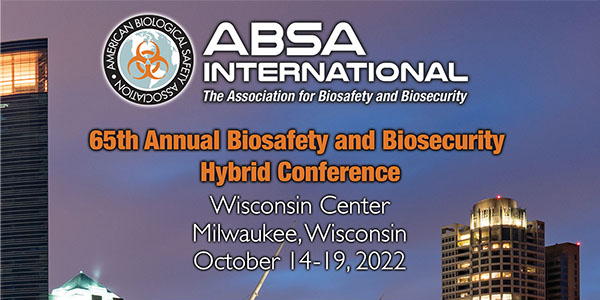
  • 65th Annual Biosafety and Biosecurity Hybrid Conference

    Wisconin Center 400 W Wisconsin Ave, Milwaukee, WI, United States

    Three full days of intensive professional development courses to educate and inspire. Three full days of state-of-the-art keynotes, papers, and panels highlighting best practices and hands-on skills crucial for today’s biosafety and biosecurity professionals. Exhibits showcasing the latest in laboratory biosafety and biosecurity products and services Invaluable networking opportunities to share and learn from other biosafety and biosecurity professionals

  • MABSA Hybrid Dinner Meeting: COVID19 Vaccine Development in the Context of High Containment

    University of Pennsylvania

    MABSA is pleased to announce our upcoming biosafety hybrid dinner meeting. Presentation:  COVID19 Vaccine Development in the Context of High Containment Speaker:  Brian J. O’Shea, Ph.D., CBSP, SM(NRCM), Associate Director - High Containment Operations, Pfizer Vaccine Research & Development Location: University of Pennsylvania, 3401 Walnut Street (3160 Chestnut Street GPS address), Philadelphia, PA 19104

  • History of Biosafety and Biowarfare

    Online

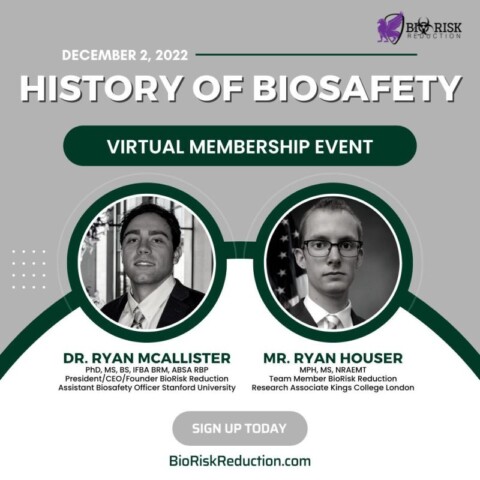
    $10 0.125 ABSA CM points #22-2256 Sign-Up Here Did you know Biosafety is a Direct Effect of Biowarfare? Learn how: Biosafety and Biosecurity have become what they are today by learning about the beginning of the Biosafety Profession through the effect of Biowarfare during World War II to Modern threats facing society. The discovery of insulin is related to the Profession of Biosafety The development of Bioweapons led to the Creation of the Biosafety Profession The Roots of the American Biological Safety Association ABSA International Biological Microorganisms could still today be used or developed for nefarious purposes The origins of [...]

    $10
  • Managing hazardous and biohazardous materials/waste in the laboratory setting

    Astra Zeneca, 1 Medimmune Way, Gaithersburg, MD 1 Medimmune Way, Gaithersburg, MD, United States

    ChABSA Technical Seminar Announcement Return to Hybrid – In Person and Virtual Option Jake Giovanucci of Triumvirate Environmental Will present on: “Managing hazardous and biohazardous materials/waste in the laboratory setting” Laboratories can generate biohazardous and hazardous waste. Confusion is not uncommon on what the differences are when it comes to disposal and handling. This webinar will review the differences and discuss proper handling and disposal of each type or waste. Potential recycling options will also be discussed. Click here to register (remember to login first to get member pricing) DATE: January 10, 2023 WHERE: Astra Zeneca, 1 Medimmune Way, Gaithersburg, [...]

  • 02. Updating Your Preparedness Toolbox for Future Outbreaks or Pandemics

    Webinar

    What’s coming next in the world? Do you have the tools you need to be prepared for the next outbreak or pandemic? Updating Your Preparedness Toolbox for Future Outbreaks or Pandemics is a roundtable discussion that will feature several biosafety and public health professionals. The panelists, who work across government, academia, industry, and public health, will discuss aspects of their institution’s response to emerging and reemerging pathogens and infectious disease emergencies. Lessons learned from previous emergencies will be shared. Topics will include risk assessment, communication challenges and solutions, program and policy changes, and occupational health.

  • ARS1V. Plant Pathology and Containment

    Zoom , United States

    The course will provide a background overview and illustration of how containment facilities for plant research can be designed, constructed, and operated to meet various standards and guidelines. The standards will be based on those given by US agencies though international entities will also be referenced. Principles of plant diseases and the organisms that cause them will be discussed as well as an emphasis on the pathways that pathogens may disseminate to new areas and using diagnosis for early and accurate detection. Case studies will be used to give an overview of systems that protect cropping systems from plant diseases. [...]

  • USDA ARS 7th International Biosafety & Biocontainment Hybrid Symposium

    Renaissance Baltimore Harborplace Hotel 202 E Pratt St, Baltimore, MD, United States

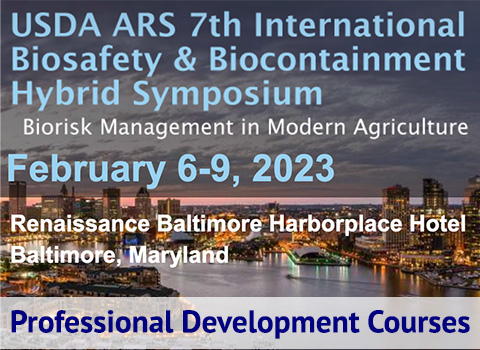
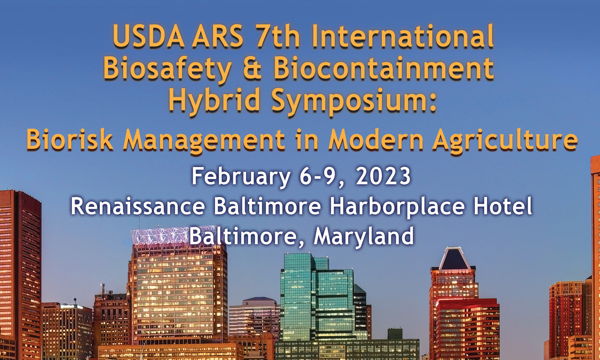
    USDA ARS 7th International Biosafety & Biocontainment Hybrid Symposium: Biorisk Management in Modern Agriculture February 6-9, 2023 Renaissance Baltimore Harborplace Hotel Baltimore, Maryland Valuable professional development courses 2½ days of scientific presentations Exhibits showcasing the latest agricultural biosafety, biosecurity, and biocontainment products and services Network with professionals from the biosafety, biosecurity, and scientific research industries, organizations, and agencies Attendees may register for the in-person event or the virtual event Approximately 200 attendees representing a broad spectrum of biosafety and biosecurity, pharmaceutical, biotechnology research, development, and clinical organizations are expected to attend. The symposium draws national and international attendees from academic, [...]

  • 01. Arthropod Research, Containment, Biosafety and Beyond

    Webinar

    Virus-based Gene Transfer Vectors is an intermediate course that will examine the molecules, processes, and techniques involved in recombinant gene expression. Participants will explore the technology of how viruses are converted into vector systems for the transfer of gene expression constructs. Common viral vector systems, including retroviruses, lentiviruses, adenoviruses, poxviruses, herpesviruses, alphaviruses, and baculoviruses will be discussed with an emphasis on the biosafety characteristics of the vectors derived from these viruses. This course is targeted for the biosafety professional who is not actively conducting laboratory research yet requires a basic understanding of recombinant DNA methodology.