Resources with keywords: training
A mechanism for capturing relevant information about each training course offered by EHS (or other group). Designed to justify the need for training from a regulatory and best practices perspective, identify key audience, and capture Training objectives and Learning objectives.
Target Audience: Regulators/Compliance personnel and trainers
This is a basic training on the NIH Guidelines for researchers, which we designed as an annual training for PIs.
Target Audience: Principal Investigators
At the end of training students will be able to…
determine whether their research should be registered and reviewed by the IBC.
You must have access to the my.ABSA.org website.
Semester Length 2 or 3 Credit Biosafety Course
(includes Powerpoints, instructor guide, syllabus, exercises, etc.)
This ‘packaged’ course can serve as a starting template for Bisoafety Professionals who are interested in teaching a biosafety course at their institution or a local educational institution. Slides for 13 lectures, and supplemental course materials are also included for interested instructors to eliminate the need to have to develop a class from scratch. A variety of course topics are included with ideas for promoting interaction within the class to help teach a comprehensive biosafety course to interested students. Course Materials were used for 5 years for teaching a Biosafety course at the Yale School of Public Health.
Target Audience: Students
At the end of training students will be able to…
- understand the science of the biosafety profession;
- have a solid understanding of the roles and responsibilities of a practicing biosafety professional;
- and also learn how to work safely in a variety of settings involving biohazards.
All of the training and instructional materials are provided at the website above and is currently located at the Yale Center for Public Health Preparedness under their educational resources. The course was assembled by Benjamin Fontes with formatting by Dr. Srdjan Stakic and others at the Yale Center for Public Health Preparedness.
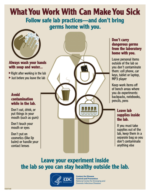 What You Work With Can Make You Sick: Follow safe lab practices—and don’t bring germs home with you. (PDF, Poster/Handouts/Factsheets/Guide)
This is a poster publicly available through the CDC that would benefit investigators,researchers, technicians, lab workers, etc. It’s an awareness poster on laboratory workers and researchers, can prevent bringing contaminates and pathogens home.
Target Audience: Laboratory Researchers
At the end of training students will be able to…
follow safe work practices to prevent bringing workplace contaminates (biological and other) home.
The Training Analysis for a BSL-2 Biomedical Laboratory was created to define all tasks and subtasks in biosafety for all persons working in an international infectious disease detection laboratory. The analysis was done using the Instructional Systems Design (ISD) methodology defined in the publication, ISD From the Ground Up1. The product is a template that can be used as a reference for developing a laboratory-based biosafety training program for BSL-2 biomedical laboratories or as a base for the development of training for microbiological and containment laboratories. This template was originally used in the design of a competency training program. Application of the training analysis in a competency training program is more fully described in “Quantifying Competency in Biosafety: Application of the Instructional Systems Design (ISD) to Biosafety and Laboratory Biosecurity”, Delarosa, P., et al., Applied Biosafety 16:3, 2011. However, this type of analysis can be applied to any training design and can be readily applied to the development of both didactic and practical training materials.
Target Audience: All persons designing biosafety training. Persons interested in competency training in Biosafety
This is a “do it yourself” methodology for the development of biosafety training that incorporates biosafety tasks into working procedures and practices in the laboratory. The goal of the training design is to accurately define all biosafety training that an individual needs to safely complete their work and establish a method for practical integration of biosafety procedures on the job.