Resources with keywords: testing
APHL has conducted a weekly survey of 99 state, local and territorial public health laboratories (PHLs) to collect the status of current and projected capability and capacity of laboratories to test for SARS-CoV-2, the virus that causes the Coronavirus Disease (COVID-19).
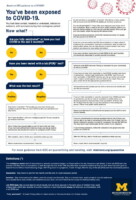 You’ve been exposed to COVID-19 - Now what? (NEW 10/15, Document, Infographic)
You had close contact, masked or unmasked, indoors or outdoors, with someone during their contagious period*. Now what?
Based on CDC guidance as of 07/30/21
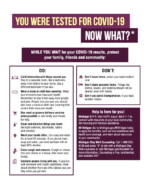 You were tested for COVID-19 now what? (NEW 10/15, Document, Regulatory, Infographic)
WHILE YOU WAIT for your COVID-19 results, protect your family, friends and community
Tande AJ, Binnicker MJ, Ting HH, Del Rio C, Jalil L, Brawner M, Carter PW,
Toomey K, Shah ND, Berbari EF
Among 9,853 passengers with a negative SARS-CoV-2 PCR performed within 72 hours of departure from December 2020 through May 2021, five (0.05%) passengers with active SARS-CoV-2 infection were identified with rapid antigen tests and confirmed with rapid molecular test performed before and after an international flight from the United States to Italy.
Work with all human specimens must be conducted according to the appropriate containment and work practices.
May 11, 2023, marked the end of the federal COVID-19 public health emergency (PHE) declaration. This doesn’t mean that COVID-19 is over, but the end of the PHE did initiate a cascade of updates to COVID-19 data collection, reporting, and surveillance. Some surveillance metrics will remain the same, but some will change in terms of reporting frequency, data sources, or availability.
Evidence Commons is the first interactive national repository of information on COVID-19 test research.