
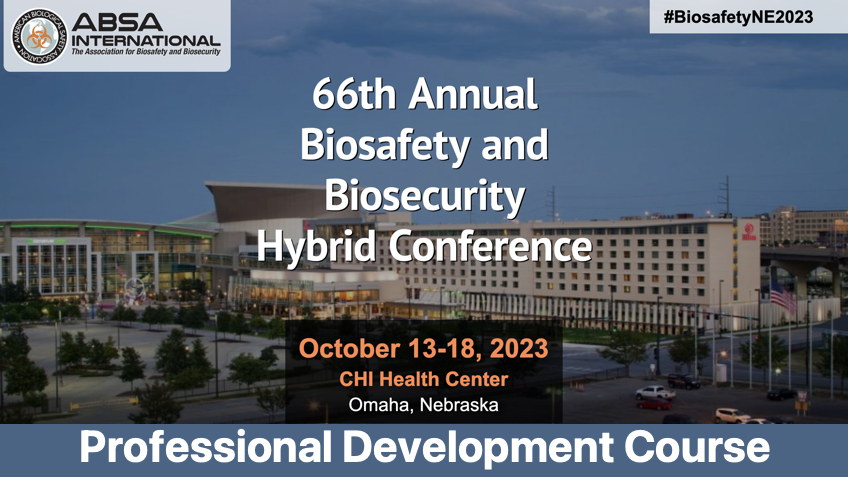
This course will discuss the importance of ensuring institutions have robust and comprehensive biosafety and biosecurity governance structures in place. Information will be provided about Federal activities related to strengthening biosafety and biosecurity practices and oversight. Participants will discuss and share tools and best practices that institutions can employ to enhance their biosafety and biosecurity programs.Participants will break into small groups to discuss a case study involving a biosafety incident occurring at an institution subject to the NIH Guidelines for Research Involving Recombinant or Synthetic Nucleic Acid Molecules (NIH Guidelines), which illustrates the importance of institutional biosafety oversight and how inadequate local oversight can result in significant problems. Participants should ideally have a working knowledge of the roles and responsibilities of institutions, Institutional Biosafety Committees (IBCs), and Institutional Review Entities (IREs) for biosafety and biosecurity oversight of research subject to the NIH Guidelines and the U.S. Government Policy for Institutional Oversight of Life Sciences Dual Use Research of Concern (DURC).
Objectives:
- Describe how to implement an effective program of biosafety and biosecurity oversight
- Paraphrase common challenges and possible solutions
- Identify tools and best practices that institutions can employ to strengthen their biosafety and biosecurity programs
- Summarize the requirements for reporting incidents under the NIH Guidelines and the importance of ensuring robust and comprehensive biosafety and biosecurity governance structures are in place
Suggested Background: IBC Basics, Background knowledge of the NIH Guidelines for Research Involving Recombinant or Synthetic Nucleic Acid Molecules
Target Audience: All Biosafety Professionals, IBC members, research compliance staff
PDC Level: Intermediate
This webinar will be one 4-hour webinar session on Tuesday, January 23, 2024, 11:30 AM – 4:00 PM CST with a 30-minute break. For the webinar, you should plan on logging in at 11:15 am (CDT) on January 23, 2024. You are required to attend the webinar session, complete the pre-course and post course assessments, and complete the evaluation in order to receive the completion certificate through the ABSA International Training Site. The link in the invitation will be unique to the user and cannot be shared.
CONTACT HOURS
This course has been approved for 0.5 CM points toward RBP/CBSP recertification. ABSA International is approved as a provider of continuing education programs in the clinical laboratory sciences by the ASCLS P.A.C.E.® Program. This course is approved for 3.5 P.A.C.E.® contact hours.